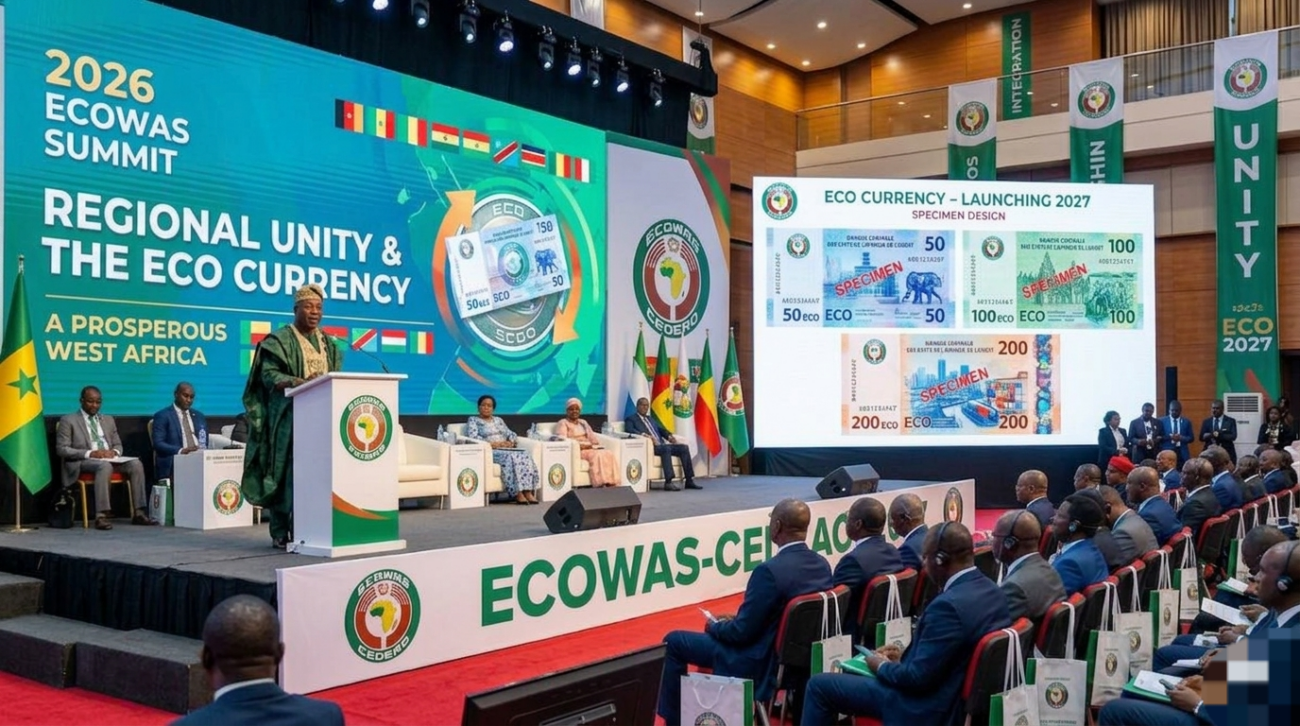
ABUJA — Inside the high-security briefing rooms of the Economic Community of West African States (ECOWAS) headquarters, Officials are frantically polishing the blueprints for the “Eco”—a long-delayed single regional currency designed to sweep away fifteen national currencies and unite 400 million people under one monetary banner.
Member countries face the challenge of meeting strict economic criteria, including low inflation and limited deficits, to join the proposed monetary system.However, achieving this goal by 2027 faces significant hurdles due to high inflation in major economies and recent political instability within the bloc. The withdrawal of several member states, including Mali, Burkina Faso, and Niger, further complicates efforts toward regional economic unity.
Historical Context and Evolutionary Roadmap
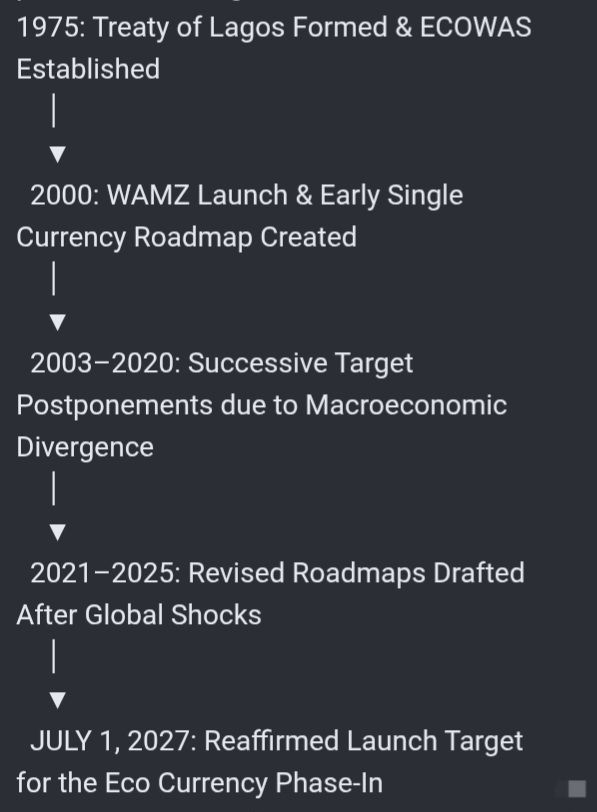
The journey toward a West African single currency is deeply intertwined with the founding vision of the regional bloc. Established via the Treaty of Lagos on May 28, 1975, ECOWAS was conceptualized as an economic union modeled closely on early European integration. Recognizing that monetary fragmentation acts as a structural barrier to commerce, leaders formally introduced the West African Monetary Zone (WAMZ) and the broader single currency roadmap in the early 2000s.
Historically, the project has faced numerous postponements. Target launch dates in 2003, 2005, 2015, and 2020 were systematically deferred due to widespread failures among member states to satisfy foundational economic preconditions. The economic disruptions brought about by the COVID-19 pandemic forced yet another massive revision of timelines.
The current timeframe establishes a roadmap leading directly to the projected July 1, 2027 launch date. This timeline represents a calculated compromise, acknowledging that monetary integration can not be rushed without risking severe market disruptions, opting instead for a strict framework of gradual convergence.
THE VISION: SMASHING THE BORDER FRICTIONS
To understand why West African leaders refuse to let the Eco project die, one only needs to look at the logistical nightmare facing local merchants. Today, a truck driving goods from Lagos to Accra must cross borders using Nigerian Naira, Benin’s CFA Franc, and Ghanaian Cedis.
Central bank governors argue that replacing this puzzle with the Eco will unlock unprecedented growth by:
- Slashing Border Surcharges: Eliminating currency conversion fees that silently drain the profits of small and medium enterprises.
- Killing Exchange Rate Shocks: Providing predictable, fixed cross-border pricing so manufacturers can safely sign long-term supply contracts.
- Fueling the AfCFTA: Acting as a localized engine to accelerate the African Continental Free Trade Area, turning West Africa into a unified powerhouse for foreign direct investment.
THE COMPLIANCE CRUNCH: INDICES THAT REFUSE TO BEND
However, central bank governors cannot print their way out of basic math. To join the Eco club, member states must satisfy a brutal gauntlet known as the Primary Convergence Criteria—and right now, most nations are failing.
In reality, global supply chain shocks, domestic food insecurity, and heavy sovereign debt burdens have driven inflation into the double digits across major regional economies. Forcing a shared currency onto nations with completely unaligned economic fundamentals risks importing severe systemic instability into the new monetary union.
THE REGIONAL DIVIDE
The operational friction deepens when analyzing the two existing monetary factions within ECOWAS. On one side stands the West African Economic and Monetary Union (WAEMU), comprised of eight mostly Francophone nations already sharing a stable currency: the CFA Franc. Backed by a fixed peg to the Euro and historically guaranteed by the French Treasury, WAEMU enjoys low inflation but faces criticism over a perceived lack of monetary sovereignty.
On the other side sits the West African Monetary Zone (WAMZ), led by the regional economic heavyweights: Nigeria and Ghana. These nations use independent, floating currencies. Nigeria alone commands over 60% of the bloc’s entire GDP. Its economy responds heavily to global oil cycles, creating an asymmetric economic rhythm that conflicts sharply with the tourism- and agriculture-dependent smaller nations of the coast.
A central point of contention is whether the Eco will float freely based on market forces—as demanded by Nigeria—or inherit a fixed currency peg to stabilize the transition for the Francophone states.
Strategic Objectives of Monetary Unification
The core economic philosophy driving the Eco is rooted in the complete elimination of artificial market frictions. In the current West African landscape, a business trading across multiple borders faces an inefficient puzzle of currency conversions. For example, moving goods from Nigeria through Benin and Togo to Ghana requires navigating the Nigerian Naira (NGN), the West African CFA Franc (XOF), and the Ghanaian Cedi (GHS).
By establishing the Eco as the sole legal tender, ECOWAS aims to unlock several transformative economic benefits:
- Reduction of Transaction Costs: Eliminating exchange fees and clearinghouse delays directly reduces the cost of doing business, making regional supply chains leaner and more competitive.
- Eradication of Exchange Rate Volatility: Intra-regional trade is frequently stifled by sudden currency devaluations. A single currency stabilizes cross-border pricing, giving manufacturers and farmers the predictability required for long-term capital investments.
- Catalyzing the AfCFTA: The Eco is viewed as a vital regional engine to accelerate the broader African Continental Free Trade Area (AfCFTA), transforming West Africa into an attractive, integrated destination for Foreign Direct Investment (FDI).
THE SAHEL EXIT: A NEW GEOPOLITICAL TWIST
For the Eco to become a globally respected fiat currency rather than an abandoned political experiment, West African leaders must look past arbitrary calendar deadlines. True unity can not be declared by a decree or printed on a banknote; it must be built through fiscal discipline, open borders, and real, structural economic alignment.
Compounding these structural design flaws is a highly volatile political landscape. The recent decisions by Burkina Faso, Mali, and Niger to withdraw from the ECOWAS political apparatus have thrown a massive wrench into administrative planning.
While these three countries have distanced themselves from the main political alliance, they remain deeply integrated into the WAEMU banking system and still use the CFA Franc. This unprecedented split leaves regional diplomats scrambling to answer a glaring question: How do you build a unified regional currency when three key territories in the heart of the trade corridor are leaving the political union?
SYSTEMIC RISK OF PHASED ADOPTION
The multi-speed plan splits West Africa into two groups: those ready to use the new money (the “in” crowd) and those left behind (the “out” crowd). People and businesses in the left-behind countries will likely panic and rush to move their savings into the safer, new money zone. This sudden cash drain will starve local banks of money, weaken their local currencies even further, and make poor countries poorer.On top of that, having some countries use the new money while neighbors stick to their old cash ruins the whole point of a shared currency. Truck drivers and business owners trading across borders will still waste time and money swapping different currencies and dealing with changing prices. This ongoing mess will cause frustration, damage regional teamwork, and push the left-behind countries to look for trade partners outside of West Africa entirely.
BENEFITS TO NIGERIA
The adoption of the Eco currency presents major structural advantages for Nigeria, which commands roughly 60 to 70 percent of West Africa’s gross domestic product. For Nigerian manufacturers and cross-border merchants, the single currency completely slashes the transaction costs and intermediate exchange fees that currently drain profits during regional trade. This frictionless environment allows local hubs to export textiles, plastics, and processed goods directly across the subcontinental corridor without relying on scarce US Dollars or facing black-market money changers. Additionally, it resolves acute foreign exchange shortages by allowing factories to source raw materials from neighboring nations using the exact same cash they use at home.
Nigeria’s booming FinTech sector and sprawling banking institutions will also gain a unified payment standard to scale operations seamlessly across 15 countries. Financial giants can pool their regional liquidity under a single regulatory framework, while tech startups can deploy digital wallets without building complex, multi-currency processing architectures. On a consumer level, anchoring Nigeria into a broader, reserve-backed monetary union protects everyday citizens from the severe currency devaluations that have historically eroded local savings. This larger, diversified financial foundation shields the Eco from sudden volatility, providing a more stable store of value and protecting the purchasing power of ordinary Nigerians.
THE WAY FORWARD: A MULTI-SPEED ECO IS THE ONLY WAY FORWARD
As the countdown to 2027 ticks on, a strict, region-wide “all-at-once” rollout appears increasingly unlikely. Insiders suggest that if the Eco debuts on time, it will take a “multi-speed” approach. A small, qualifying core of economically disciplined nations will adopt the currency first, leaving a structural “docking mechanism” for lagging economies to join later as their indicators stabilize.
This multi-speed strategy mirrors the early operational days of the European Union’s Eurozone, where a vanguard of ready economies established the common framework before absorbing peripheral nations. By shielding the initial rollout from the volatile fiscal strains of lagging member states, ECOWAS can protect the infant currency’s global credibility and credit rating from day one.
For the secondary nations, this phased transition acts as a forced economic stabilizer. Countries waiting to “dock” will be required to undergo strict domestic structural adjustments, overseen by regional central bank monitors, to align their national metrics with the Eco’s rigid criteria.Ultimately, a gradual integration prevents an unmanageable economic shock to local supply chains. By allowing cross-border commercial networks to test payment integration progressively, West African businesses can adjust to the new regional standard without facing sudden liquidity shortfalls.