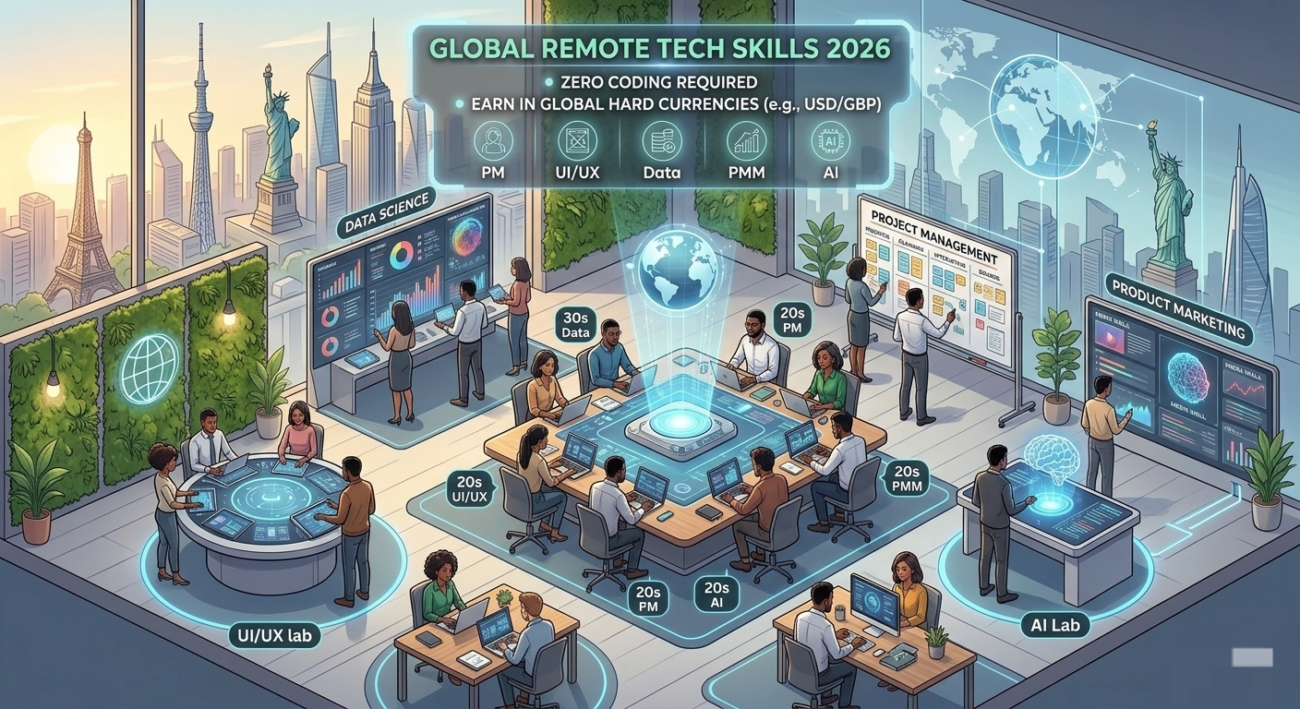
The top 5 high-paying remote tech skills for Nigerians in 2026 that require zero coding are product management, UI/UX product design, data analysis, Product Marketing Management, and AI prompt engineering. These non-coding roles allow you to secure foreign remote jobs and earn in hard currency (USD/GBP) straight from Nigeria. Global platforms favour practical expertise, meaning a strong digital portfolio outweighs a computer science degree.
To capitalize on these opportunities, you must shift your focus from traditional certificates to building a proof-of-work ecosystem. Navigating the international remote market requires an optimized LinkedIn profile, a curated portfolio showcasing real-world problem-solving, and active presence on freelancing platforms like Upwork or specialized remote job boards. Mastering these roles bridges the gap between local economic limitations and international wealth, granting financial freedom without writing a single line of code. Continuous upskilling in AI-driven tools within these domains will ensure you remain highly competitive, irreplaceable, and positioned for rapid career advancement in the global marketplace.
Product Management
Product managers act as the “CEO” of a digital product. They bridge the gap between business goals, user needs, and software engineering teams without writing code.
- Average Global Remote Salary: $3,000 – $5,000+ monthly.
- Core Tools: Jira, Asana, Notion, Productboard, Trello.
- How to Build a Portfolio: Write a comprehensive product case study. Document exactly how you would improve specific features on popular African apps like Bolt or PiggyVest.
2. UI/UX Product Design
UI/UX designers focus on user psychology and visual design. They map user journeys and create the visual layout of apps and websites before developers build them.
- Average Global Remote Salary: $1,800 – $3,000 monthly.
- Core Tools: Figma, Adobe XD, Miro, Maze.
- How to Build a Portfolio: Redesign a poorly optimized platform, such as a Nigerian banking app. Host your interactive prototypes on Behance or a personal website.
3. Data Analysis (No-Code Track)
Data Analysts translate complex numbers into actionable business strategies. While some tracks use Python, the non-coding track relies heavily on spreadsheets and visual dashboards.
- Average Global Remote Salary: $2,000 – $3,500 monthly.
- Core Tools: Microsoft Excel, Power BI, Tableau, Google Sheets.
- How to Build a Portfolio: Clean and analyze public datasets from platforms like Kaggle. Build interactive visual dashboards on Tableau Public to showcase your findings.
4. Product Marketing Management
Product Marketing Managers handle launching a tech product to the market. They oversee positioning, messaging, and customer acquisition strategies rather than managing standard social media accounts.
- Average Global Remote Salary: $2,500 – $4,500 monthly.
- Core Tools: Google Analytics, HubSpot, Mailchimp, SEMrush.
- How to Build a Portfolio: Create a Go-To-Market (GTM) launch strategy for a fictional tech startup. Highlight user research, competitive analysis, and conversion funnel strategies.
5. AI Prompt Engineering & Operations
- Average Global Remote Salary: $2,000 – $4,000 monthly.
- Core Tools: ChatGPT Enterprise, Midjourney, Claude, Zapier (for AI automation).
- How to Build a Portfolio: Build and document custom AI workflows or GPTs on GitHub or Notion. Demonstrate how your specific prompt sequence cuts business operational costs.
Step-by-Step Launch Roadmap
Phase 1: Months 1–2 — Foundations & Certification
- Structured Learning: Earn industry-recognized credentials like Google Career Certificates or IBM courses on Coursera using financial aid options to learn risk-free.
- Tool Mastery: Avoid generic theory. Spend 2 hours daily inside platforms like Figma for design, Jira Software for management, or Tableau Public for data analytics until navigation becomes second nature.
Phase 2: Months 3–4 — Portfolio Architecture
- Local Audits & Redesigns: Choose 2 poorly optimized local apps or business problems and document how you would fix them. Turn these into detailed, step-by-step case studies.
- Public Hosting: Do not hide your work in PDF files. Publish your visual prototypes on Behance or build a clean, interactive resume dashboard using Notion.
Phase 3: Months 5–6 — Global Job Outreach
- Freelance Setup: Create optimized profiles on Upwork and Fiverr. Submit 5 tailored proposals every week targeting entry-level, foreign contract jobs.
- LinkedIn Optimization: Rewrite your profile headline to target specific keywords (e.g., “Remote UI/UX Designer”). Connect with international recruiters and apply directly to vetted tech ecosystems like the Andela Talent Network.
Overcoming the Nigerian Tech Hurdles)
How do I handle Nigeria’s constant electricity and internet issues?
Do not let infrastructure stop you. Successful remote workers use a dual-network system (e.g., MTN fibre plus an Airtel router as backup) to ensure continuous connectivity. Invest in a reliable mini-UPS or solar inverter system specifically to power your router and laptop during blackouts. Additionally, locate a local tech hub or co-working space in your city where you can work during critical sprint deadlines or international client meetings.
How do I compete with tech talent from India, Eastern Europe, or Latin America?
You compete by building a hyper-specific niche and leveraging Nigeria’s strong English proficiency. Instead of marketing yourself as a general “Data Analyst,” position yourself as a “Data Analyst for E-commerce Brands.This specific positioning allows you to target companies needing your precise expertise, taking you out of competition with the broader mass market.
Can I really get hired by a US or UK company without a university degree?
Yes, absolutely. International tech recruiters prioritize your digital portfolio over formal university degrees. A highly detailed, interactive portfolio hosted on Notion or Behance acts as your actual degree in the remote tech ecosystem. If your case studies prove you can solve their exact business problems, they will hire you regardless of your academic background.
How to Receive USD/GBP Payments in Nigeria
- Geegpay for Africa: This platform lets you create fully functional, virtual USD, GBP, and EUR bank accounts. You can give these account details directly to your foreign clients or link them to Upwork to receive your payouts instantly.
- Payoneer: A globally trusted platform used by major freelancing networks. It integrates seamlessly with Upwork and Fiverr, allowing you to withdraw your earnings directly into your local Nigerian bank account.
- Grey Finance: This digital platform provides foreign virtual accounts specifically tailored for African freelancers and remote workers, offering rapid conversion rates directly to Naira.
The bottom line is this: the global tech ecosystem no longer cares about where your physical desk is located, what university degree you hold, or how many lines of code you can write—it only cares about the tangible problems you can solve. By committing to this six-month blueprint, you are leveraging currency arbitrage, turning your skills into a hedge against local inflation, and positioning yourself to earn in dominant foreign currencies right from Nigeria. The transition from an observer to a high-earning global tech professional requires nothing more than consistency, a reliable internet connection, and the audacity to build in public. Stop waiting for the local job market to favor you; upskill, build your proof of work, and command your worth on the global stage starting today.