
Human consciousness is fundamentally governed by a tripartite psychological framework comprising identity, intention, and behaviour. In an ideal state of self-awareness, these three elements function as a perfectly synchronized triangle, each vertex directly supporting and reinforcing the others. Identity establishes who a person is, intention dictates who they aim to be in a given moment, and behaviour serves as the physical manifestation of those internal states.
However, human existence is rarely perfectly synchronized. Instead, individuals frequently encounter the “alignment paradox”—a psychological phenomenon where a person’s deeply held sense of self and their positive intentions fail to manifest in their actual, real-world actions. This disconnect creates profound internal friction, often leading to cognitive dissonance, fractured relationships, and a persistent sense of personal inauthenticity. Bridging this personal divide requires a rigorous commitment to self-awareness, an understanding of the systemic barriers to alignment, and the deliberate cultivation of psychological congruence.
To comprehend the nature of the alignment paradox, one must first deconstruct the individual components of the self-awareness triangle.
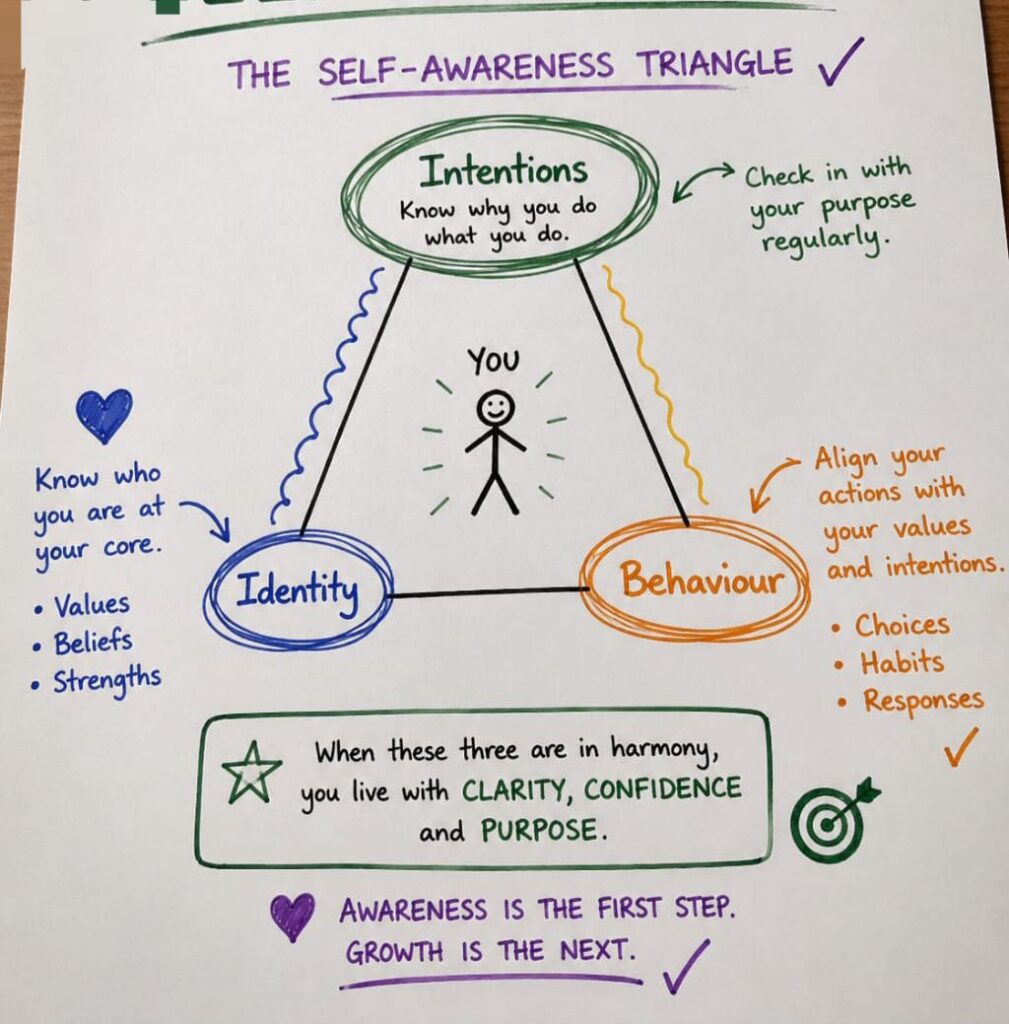
Identity
Identity forms the foundational base of the psychological triangle. It is the complex, internalized narrative that an individual constructs about themselves over a lifetime. This narrative is forged from core values, cultural background, belief systems, memories, and personality traits. Identity answers the existential question, “Who am I?” It serves as the internal compass from which all moral and ethical boundaries are drawn. Because identity feels permanent and deeply personal, people fiercely protect it, striving to view themselves as inherently good, capable, and well-intentioned.
Intention
Intention represents the cognitive bridge between identity and the external world. It is the realm of conscious planning, goal-setting, and immediate desires. When an individual possesses a specific identity—such as a “kind person” or a “disciplined professional”—their intentions naturally align with that identity. Intentions are inherently forward-looking and highly idealistic; they reflect what an individual means to do or how they wish to impact their environment. Because intentions remain private thoughts confined to the mind, they are free from the harsh constraints, friction, and messy compromises of physical reality.
Behaviour
Behaviour is the final vertex, representing the only visible, measurable component of the triangle. It is the execution of action in the physical world. While identity and intention exist purely within the subjective realm of the mind, behaviour is objective, observable, and impactful to others. It is through behaviour that relationships are formed, work is accomplished, and character is ultimately judged by society. The alignment paradox occurs precisely at this juncture: when the observable output of behaviour contradicts the unobservable purity of identity and intention.
The Core of the Paradox: Why We Misalign
The primary driver of the alignment paradox is the fundamental psychological asymmetry in how human beings judge themselves versus how they judge others. This is closely related to the fundamental attribution error in social psychology. Individuals judge themselves by the purity of their secret intentions, yet they judge everyone else strictly by their visible behaviours. When a person acts out of character—such as snapping at a colleague or neglecting a critical responsibility—they immediately excuse the behaviour by pointing to their internal state. They soothe their conscience by thinking, “I didn’t mean to be hurtful, and I am still a good person.
“However, this internal defense mechanism masks a deeper systemic failure. The mind uses intentions as a psychological shield to protect the ego from the painful realization that its behaviour has violated its identity. This creates a state of functional hypocrisy. A person can comfortably maintain an identity of being a healthy, disciplined individual while simultaneously engaging in daily habits of procrastination and poor physical wellness. The paradox deepens because the longer this misalignment persists, the more the subconscious mind recognizes the fraud. The ego attempts to maintain the illusion of harmony, but the underlying tension manifests as chronic stress, anxiety, and a fragmented sense of self.
Furthermore, intentions are incredibly cheap to manufacture, whereas constructive behaviour requires significant physiological and cognitive energy. The brain is naturally wired for energy conservation, meaning it will inherently opt for the path of least resistance when fatigued, stressed, or placed under environmental pressure. When cognitive resources are depleted, the unconscious mind defaults to deeply ingrained habits, survival instincts, and immediate emotional reactions. Consequently, even the most noble intentions are easily hijacked by situational pressures, emotional triggers, or physical exhaustion, leaving a trail of destructive or negligent behaviours that actively sabotage the individual’s core identity.
The Psychological and Social Consequences
Living within the fracture of the alignment paradox carries severe psychological penalties, chief among them being chronic cognitive dissonance. When actions consistently betray core beliefs, the mind enters a state of psychological discomfort. To resolve this pain without changing their behaviour, individuals frequently resort to maladaptive coping mechanisms such as rationalization, denial, and psychological projection. They blame external circumstances, stress, or the perceived provocations of others for their actions. Over time, this erosion of personal accountability weakens self-trust. When an individual repeatedly breaks promises made to themselves, their self-esteem plummets, leading to an internalized sense of helplessness and fraudulence.
On a social level, the consequences of the alignment paradox are equally devastating to interpersonal relationships. Trust is not built on what people think or feel internally; it is built exclusively on behavioural predictability and consistency. When a person’s stated intentions or self-proclaimed identity consistently mismatch their external actions, observers perceive them as untrustworthy, manipulative, or radically unreliable.
For instance, a leader who identifies as “people-centric” but routinely micro-manages and dismisses employee feedback will rapidly alienate their team. The leader may feel misunderstood, genuinely believing their intentions were protective, but the team only experiences the restrictive behaviour. This communicative chasm breeds resentment, as the misaligned individual feels chronically misjudged, while those around them feel consistently let down.
Strategic Frameworks for Bridging the Divide
Resolving the alignment paradox requires transforming self-awareness from a passive state of reflection into an active, operational practice. To successfully bridge the personal divide between identity, intention, and behaviour, individuals must intentionally implement specific cognitive and behavioural strategies.
• Radical Habit Auditing and Behavioural Tracking
Because the human mind is highly adept at self-deception, subjective self-assessment is fundamentally unreliable for achieving true alignment. Individuals must introduce objective metrics to evaluate their actions. This involves maintaining a systematic log of daily choices, time allocation, and emotional reactions.
By comparing this hard behavioural data directly against stated values, the illusions created by comfortable intentions are instantly shattered. If a person identifies as a dedicated mentor but an audit reveals they haven’t scheduled a developmental conversation in months, the data forces an immediate, undeniable confrontation with reality, compelling course correction.
• Implementation Intentions and Action Triggers
Vague, overly idealistic intentions (e.g., “I intend to be more patient today”) lack the structural operational framework required to withstand real-world stress. Psychological research demonstrates that formatting intentions into strict, conditional statements drastically increases the likelihood of execution.
By utilizing “If-Then” planning, individuals can map out exact behavioural responses to specific environmental triggers ahead of time. For example: “If a colleague interrupts me during a presentation, then I will take one deep breath and ask them to hold their thought until the end.” This technique effectively bypasses the need for conscious, real-time willpower, automating aligned behaviour when emotional volatility is high.
• Closing the Feedback Loop via External Accountability
Self-awareness can not exist in a vacuum or solely within the confines of one’s own mind. To counteract personal biases, individuals must actively seek out external feedback from trusted, objective sources, such as peers, mentors, or professional coaches.Granting others permission to point out blind spots and call out inconsistencies between one’s proclaimed identity and actual actions provides an invaluable external mirror. While receiving this feedback can initially wound the ego, it provides the precise Behavioural diagnostic data required to repair the fractured vertices of the self-awareness triangle.
• Downscaling Intentions to Match Current Capacity
A common trap that exacerbates the alignment paradox is setting monumental intentions that far exceed one’s current emotional, psychological, or physical capacity. When individuals set goals that are too large, they inevitably fail, which only deepens the cycle of self-distrust.
Bridging the divide requires radically downscaling intentions into micro-behaviours that are practically impossible to fail at, even on one’s worst days. Instead of intending to revolutionize an entire organizational workflow, the intention should be narrowed to improving a single communication protocol. Consistently executing micro-behaviours builds foundational momentum, gradually rewires the subconscious self-image, and systematically aligns actions with identity.
The Journey Toward Congruence
The alignment paradox is not a permanent character flaw, but rather an inherent feature of the complex human condition. The divide separating identity, intention, and behaviour will naturally widen whenever an individual operates on autopilot, succumbs to environmental pressures, or allows self-deception to shield their ego from uncomfortable realities. True self-awareness is never a static destination or a theoretical concept to be checked off; it is an active, daily practice of closing the gap between the internal self and external execution.
Achieving psychological congruence requires the courage to dismantle protective rationalizations and look honestly at the objective data of one’s life. When intentions are forged with precision and behaviours are measured with unyielding honesty, the triangle of self-awareness stabilizes. By systematically ensuring that actions directly reflect internal values, the destructive friction of the paradox dissolves. In its place emerges a powerful, unified state of authenticity, where who you believe you are, what you mean to do, and what you actually execute become one and the same.