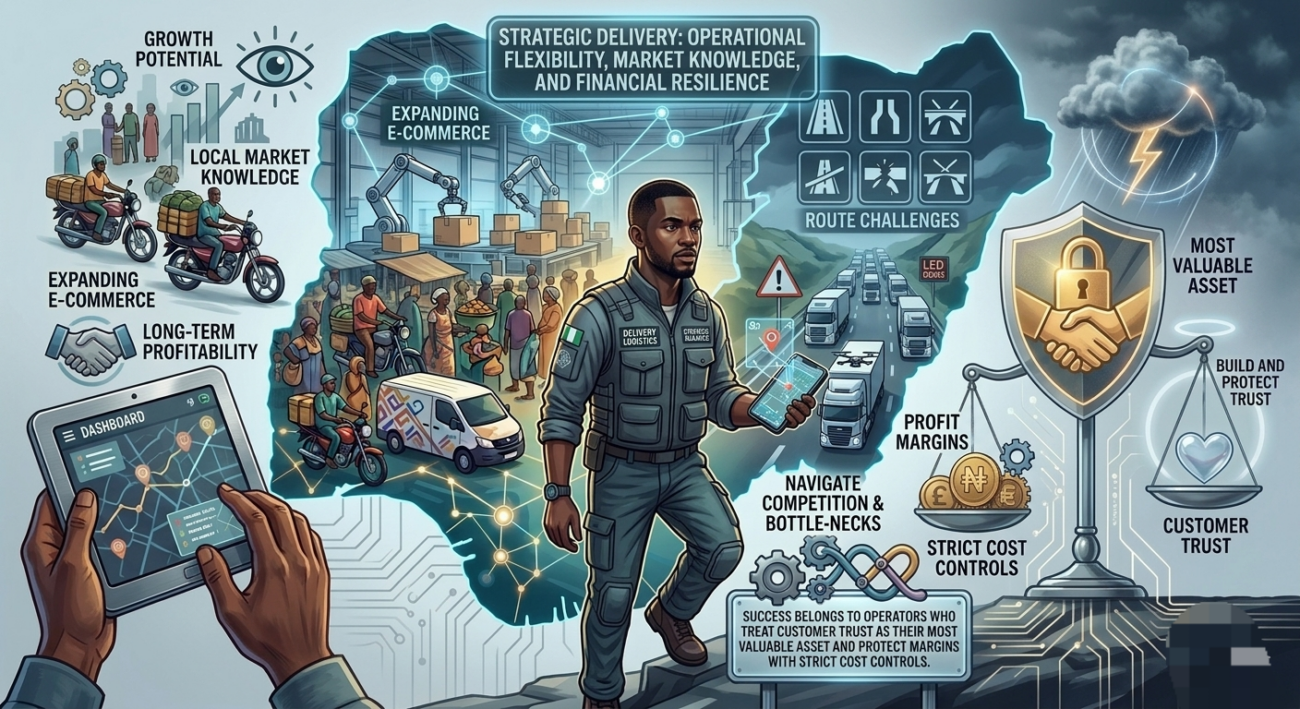
Starting a logistics and delivery business in Nigeria is a high-reward venture driven by a booming e-commerce sector, expanding urban centres, and a rising demand for reliable last-mile delivery. Small online retail brands, local restaurants, and corporate offices rely on efficient courier providers every day. However, navigating this sector requires a deep understanding of strict regulatory legal structures, steep operational costs, and local micro-economic bottlenecks.
If you are a serious entrepreneur looking to deploy capital efficiently in this sector, this master guide provides an end-to-end blueprint covering strategic planning, entry barriers, financial projections, and mitigating major day-to-day challenges.
1. Choosing Your Logistics Niche and Operating Model
The biggest mistake new operators make is trying to provide “all services to everywhere.To succeed, you must specialize in a distinct segment based on your financial strength and resource capacity.
Intra-City Last-Mile Delivery
- Core Focus: Delivering small packages, clothing, electronics, document waybills, and fast food within a single metropolitan city (such as Lagos, Abuja, Port Harcourt, or Ibadan)
- Primary Assets: Fleet of 150cc to 200cc motorcycles (e.g., Boxer, Daylong, Qlink) or electric bikes equipped with secured dispatch insulation boxes.
- Target Audience: Instagram and WhatsApp vendors, local boutique stores, pharmacies, and quick-service food joints.
Inter-City Logistics and Courier ServicesCore
- Focus: Moving commercial parcels, cargo, and freight shipments across state borders (e.g., Lagos to Onitsha, or Kaduna to Abuja)
- Primary Assets: Mid-sized delivery vans, minibuses (such as Suzuki “Every” vans), or 3-ton to 5-ton trucks.
- Target Audience: Wholesalers, manufacturing businesses, and cross-border e-commerce hubs.
2. Regulatory Compliance and Legal Setup
Skipping legal registration will result in heavy fines, vehicle seizures by law enforcement, and a total lack of trust from corporate clients. A legitimate setup requires multi-layered clearance.
Corporate Affairs Commission (CAMA Registration)
You must register your company with the Corporate Affairs Commission (CAC). While a basic “Business Name” is cheaper, registering a Private Limited Liability Company (LTD) is highly recommended. To qualify for federal logistics courier licensing, your documentation must explicitly state logistics/courier services as your primary business objective and carry a minimum authorized share capital of ₦2,000,000.
NIPOST Courier License
The Courier and Logistics Regulatory Department (CLRD) under NIPOST enforces mandatory operator licensing. Fees are broken down into specific tiers depending on operational range:
State/Special SME License: Approximately ₦250,000.
Regional License: Approximately ₦2,000,000.
National License: Approximately ₦3,000,000.
Local Government and State Permits
For local intra-city operations, your vehicles require a variety of permits to avoid harassment on the road. These include State Carriage Permits, Ministry of Transport (MOT) test certificates, Local Government Area (LGA) branding permits, and Hackney Permits.
3. Financial Projections: Cost Breakdown (2026 Blueprint)
Launching a lean but legally secure logistics startup with a fleet of two dispatch motorcycles requires a clear budget layout. The financial breakdown below outlines realistic estimates for a small-scale operation
To start a logistics and delivery business in Nigeria, you need a minimum capital of ₦3,500,000 to ₦7,500,000 for a small-scale operation (2–3 bikes). Though you can research second-hand vehicles, it is highly recommended to purchase new vehicles for long-term durability.
Setup and Capital Expenses
Vehicle Procurement
- Estimated Cost: ₦1,200,000 – ₦1,800,000 per asset
- Operational Details: Brand new Bajaj or Jincheng bikes are preferred for long-term durability.
NIPOST License
- Estimated Cost: ₦250,000 – ₦2,000,000
- Operational Details: Municipal or State licenses cost less; National licenses cost significantly more.
State & Local Levies
- Estimated Cost: ₦100,000 – ₦200,000 per bike
- Operational Details: Local government paperwork, stage carriage, and hackney permits are mandatory.
• Dispatch Gear
- Estimated Cost: ₦80,000 – ₦150,000 per rider
- Operational Details: High-grade fiberglass boxes, branded reflective jackets, and helmets.
•Mobile Tech & Tracking
- Estimated Cost: ₦50,000 – ₦120,000 per asset
- Operational Details: GPS tracking hardware installation and baseline mobile data subscriptions.
4. Critical Operational Challenges
Rider Management & Poaching
- Riders frequently mismanage vehicles or quit without notice.
- Competitors regularly poach experienced riders by offering slightly higher daily returns.
Extortion and Harassment
- Local state actors and area boys frequently stop riders for illegal levies.
- Missing a single state paper can ground your asset for days
High Maintenance Costs
- Poor road networks accelerate vehicle wear and tear.
- Fuel price volatility directly impacts your daily profit margins.
5-Step Action Plan to Launch
- Register Your Business: Formalize your entity name through the Corporate Affairs Commission (CAC).
- Secure the Capital: Buffer your budget with at least 3 months of working capital for fuel and maintenance.
- Acquire Assets and Insure: Buy durable bikes and secure goods in Transit (GIT) insurance to cover lost or damaged parcels.
- Deploy Tracking Software: Install real-time GPS trackers before any bike goes on its first delivery route.
- Draft Rider Contracts: Use binding legal agreements with guarantors to prevent asset theft or sudden abandonment.
Hidden Operating Costs to Budget For
Many new logistics owners fail because they spend all their money on setup and leave nothing for daily operations. You must maintain a cash buffer for these recurring expenses
- Fuel Volatility: Fuel prices change rapidly. Budget at least ₦5,000 to ₦8,000 daily per bike, depending on your operational routes.
- Routine Maintenance: Nigerian roads cause rapid wear and tear. Budget ₦20,000 monthly per bike for routine oil changes, tire punctures, and brake pad replacements.
- Goods in Transit (GIT) Insurance: This covers the financial cost of items that are lost, stolen, or damaged while your rider is making a delivery. It is vital for building trust with high-value clients.
Starting a logistics and delivery business in Nigeria requires a balance of strong operational flexibility, deep local market knowledge,and financial resilience.While the sector offers massive growth potential due to expanding e-commerce and trading networks,long-term profitability depends on your ability to navigate intense competition and unpredictable operational bottlenecks.Success belongs to operators who treat customer trust as their most valuable asset and protect their profit margins with strict cost controls.