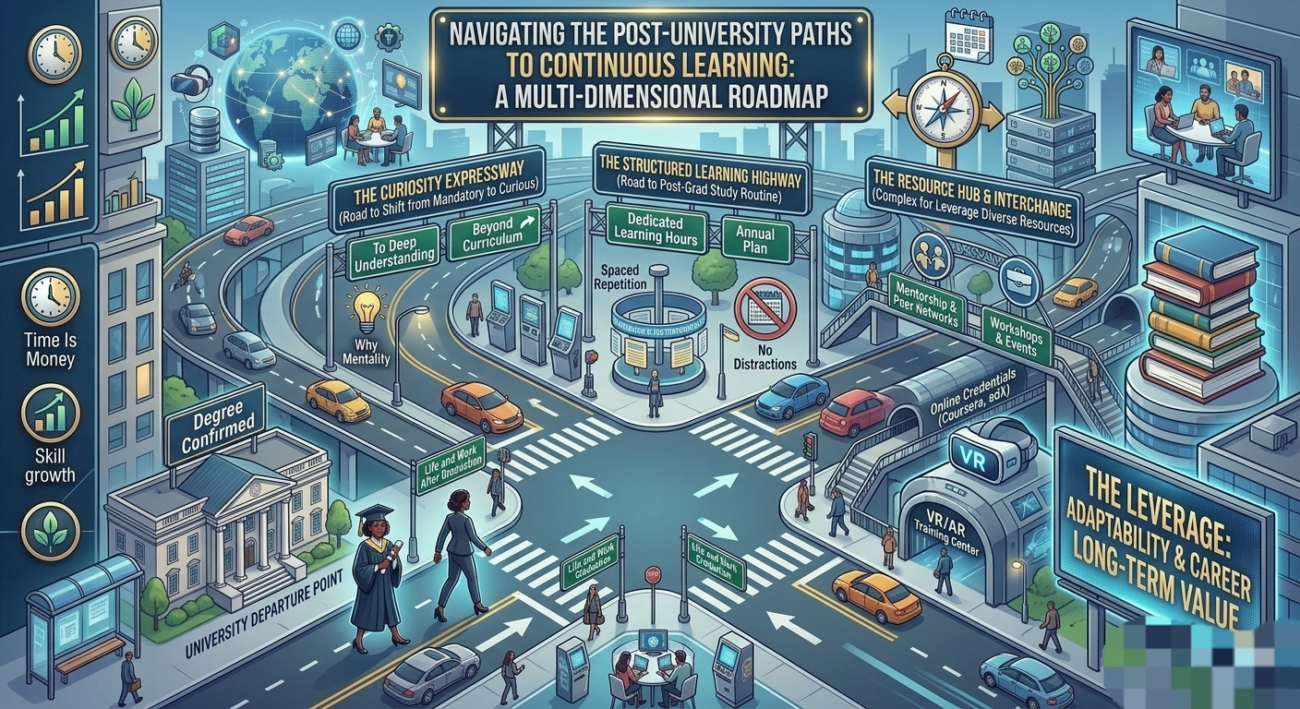
The transition from university to the professional world marks a fundamental shift in how knowledge is acquired, processed, and applied. In academia, learning is highly structured, externally enforced, and linear. Syllabi dictate the timeline, professors provide the material, and examinations offer immediate, quantifiable feedback. This environment creates a form of forced discipline.
Once the framework of higher education is removed, individuals enter a decentralized professional landscape. In this space, skills degrade rapidly due to technological advancements and shifting market demands. The responsibility for intellectual growth shifts entirely to the individual.
Building the discipline of continuous learning after graduation is not about reproducing the intensity of university finals. It requires establishing a self-sustaining system driven by internal motivation, structured habits, and practical application.
1. The Post-Graduate Paradigm Shift
Developing post-university discipline requires changing your underlying mindset regarding education. When external enforcement disappears, your internal framework must adapt.
Transitioning from Reactive to Proactive Education
University students are largely reactive learners. They respond to assignments, lecture schedules, and exam dates. In the professional arena, waiting to be told what to learn results in stagnation. Proactive education means identifying gaps in your current knowledge base and independently seeking resources to fill them before those gaps negatively impact your career performance.
Overcoming the “Completion” Fallacy
A university degree often creates the illusion that education has a definitive endpoint. This completion fallacy causes professionals to treat their graduation date as the finish line of their intellectual development. In reality, a degree is merely a baseline. Continuous learning requires viewing your mind as a dynamic system that demands constant updates, maintenance, and optimization to remain relevant.
Managing the Absence of Institutional Feedback
In higher education, your progress is certified by grades and transcripts. In the real world, feedback loops are prolonged and often ambiguous. You may learn a new skill and not see its professional yield for months or even years. To maintain discipline without immediate validation, you must detach from short-term rewards and find satisfaction in the compounding value of daily incremental progress.
2. Designing an Implementation System
Discipline is not a static character trait or a byproduct of fleeting bursts of motivation. It is the result of reliable, friction-free systems. To learn consistently, you must build an environment where choosing to learn is easier than choosing distraction.
Deconstructing Goals into Micro-Habits
Vague goals like “learn data science” or “understand macroeconomics” paralyze progress because they lack clear entry points. To build consistent momentum, deconstruct massive disciplines into tiny, actionable micro-habits.
Instead of aiming for hours of ambiguous study, set explicit, manageable targets:
- Read exactly five pages of an industry text per day.
- Complete one coding exercise every morning before checking email.
- Analyze one corporate case study per week.
- These micro-habits reduce cognitive friction, making it easier to begin. Over time, these small actions compound into deep expertise.
Time-Blocking and Environmental Design
If you do not intentionally schedule time for learning, daily administrative tasks and personal fatigue will inevitably crowd it out. Treat learning blocks as critical professional appointments.
- Calendar Integration: Block out a non-negotiable 30 to 45 minutes in your digital calendar every day. For most young professionals, the early morning—before the demands of the workday begin—is the most reliable window.
- Friction Reduction: Prepare your environment the night before. Leave your book open to the correct page, keep your online course tab active on your desktop, and place your notebooks on your desk.
- Distraction Elimination: Put your phone in another room and use website blockers during your learning window. Eliminating options ensures your focus remains entirely on the task at hand.
Capitalizing on Found Time
The modern professional schedule contains hidden windows of passive time that can be reclaimed for education. This “found time” includes daily commutes, household chores, meal preparation, and exercise sessions. By substituting entertainment for educational podcasts, audiobooks, and narrated industry briefs, you can easily integrate 5 to 10 hours of foundational learning into your week without altering your core work schedule.
3. Curating High-Utility Streams
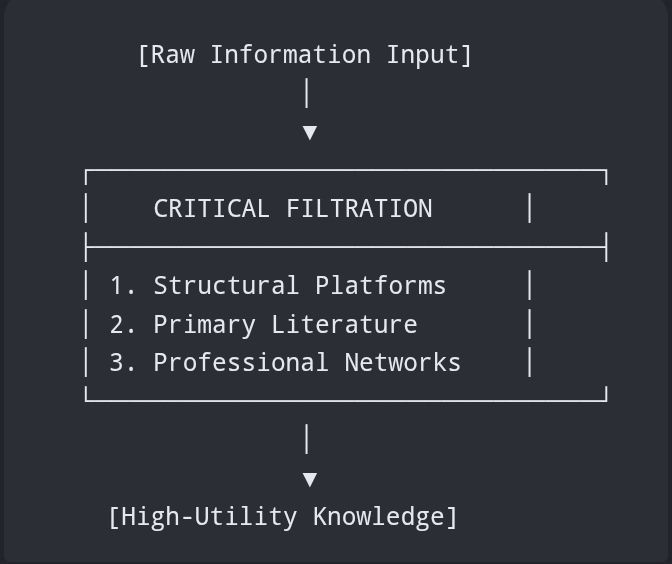
The internet provides unprecedented access to information, creating a secondary problem: information overload. Without strict curation, your learning time can easily be consumed by low-value, repetitive, or sensationalist content.
Selecting Structural Learning Platforms
When entering a completely foreign field, structured online platforms prevent you from getting lost in a sea of disconnected articles. Use platforms like Coursera, edX, LinkedIn Learning, and specialized bootcamps to build your foundational frameworks. These ecosystems provide a logical progression of ideas, guided exercises, and milestones that replicate the structured benefits of a university curriculum without rigid scheduling constraints.
Engaging with Primary and Specialized Literature
To move beyond surface-level insights, you must bypass secondary commentary and go straight to primary sources.
- Industry Whitepapers: Read comprehensive technical studies produced by top-tier consulting firms, research institutions, and corporate think tanks.
- Academic Journals: Use databases like Google Scholar to track peer-reviewed breakthroughs in your sector.
- Specialized Monographs: Invest time in reading dense, single-subject books authored by field experts, rather than relying solely on generalized, fast-paced business literature.
Transforming Social Media into an Automated Syllabus
Social media algorithms feed on user behaviour. If you use your accounts solely for passive entertainment, your feeds will reflect that choice. You can consciously weaponize these algorithms to automate your continuous learning. Purge accounts that trigger passive scrolling. Replace them with industry researchers, specialized practitioners, academic journals, and corporate analysts. This ensures that opening a social media application naturally exposes you to relevant industry trends, data visualizations, and technical discussions.
4. The Execution and Integration Framework
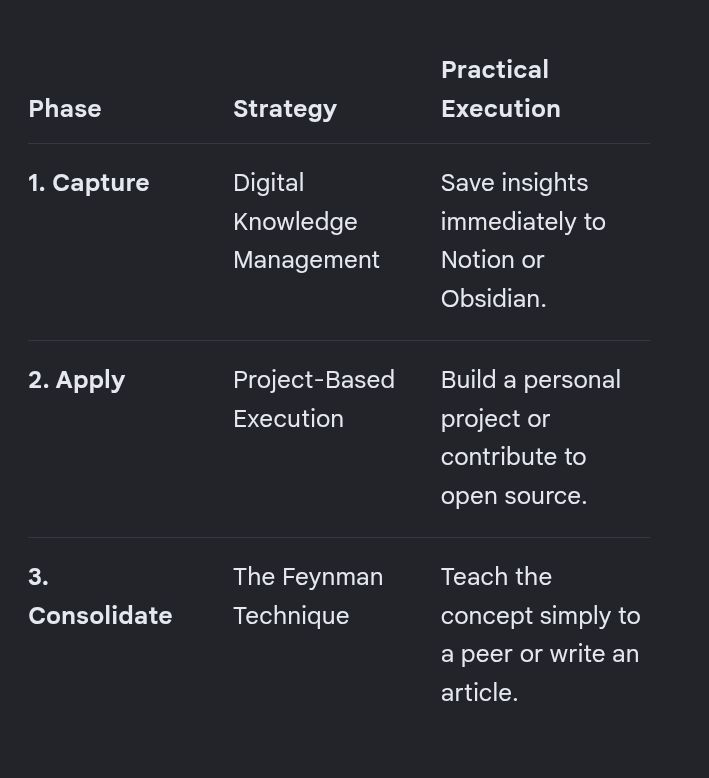
Pure consumption does not equal learning. True understanding occurs when information is processed, tested, and integrated into your mental models through active application.
Building a Second Brain
Human memory is poorly optimized for storage but highly optimized for processing. When consuming high-value information, establish a standardized system to capture, categorize, and store insights. Use digital tools like Notion, Obsidian, or Roam Research to maintain a searchable knowledge database. Document code snippets, core theories, framework models, and insightful quotes. This practice prevents you from needing to relearn concepts from scratch when you need to deploy them months later.
Project-Based Learning
Theoretical knowledge degrades rapidly without immediate practical use. The fastest way to solidify a new skill is to construct a real-world project around it.
- If you are learning programming, build a functional application that addresses a personal pain point.
- If you are studying digital marketing, launch a small test campaign for a local business or a personal portfolio.
- If you are learning financial modelling, download public corporate financial statements and independently construct your own valuation matrices.
Forcing your hands to do the work reveals the hidden gaps in your understanding that reading alone can not uncover
Deconstructing Complex Ideas via the Feynman Technique
To verify that you genuinely understand a newly acquired concept, use the Feynman Technique. Attempt to explain the topic in simple, universal language to someone who has no background in the field. Eliminate all technical jargon and complex terminology. If you find yourself struggling to explain a step clearly, or if you must resort to complex buzzwords to mask a gap in your logic, you have identified the exact boundaries of your current understanding. Return to your resources, patch that specific gap, and repeat the process.
5. Navigating Professional and Social Ecosystems
Learning should not occur in complete isolation. Your social and professional environments can act as powerful structural guardrails that help sustain your personal learning discipline over the course of your career.
Cultivating an Intellectual Peer Group
It is incredibly difficult to maintain a rigorous self-study regimen if your immediate social circle prioritizes complacency. Seek out peers who share your professional ambitions and intellectual curiosity. Form informal study clubs, book review circles, or accountability pairings. Knowing that you have a weekly meeting to discuss a specific text or project introduces a healthy form of social accountability that mimics the peer dynamics of university seminars.
Maximizing Workplace Resources
Many young professionals overlook the internal educational resources offered by their employers.
- Educational Stipends: Check if your company offers annual allowances for books, courses, certifications, or conference attendance.
- Internal Knowledge Bases: Explore your organization’s internal wikis, technical documentation, and post-project reviews.
- Cross-Departmental Shadowing: Request opportunities to shadow colleagues in different departments to gain a broader understanding of how your company functions as a whole.
Establishing Strategic Mentorship Loops
Identify senior professionals in your field whose career trajectories and technical skill sets align with your long-term goals. When approaching potential mentors, avoid vague requests like “will you be my mentor?” Instead, come prepared with highly specific questions regarding their learning habits, industry perspectives, or technical approaches. Show them how you have applied their previous advice to your work. Senior professionals are far more likely to invest their time in young graduates who demonstrate a proven commitment to self-directed growth.
The Long-Term Compounding Effect
Building the discipline of continuous learning after university is a challenging but necessary process. It requires moving away from the comforting guardrails of institutional education and designing your own self-directed routines. By fundamentally shifting your mindset, building friction-free habit systems, curating high-utility information, and prioritizing project-based application, you convert learning from an occasional chore into an automatic default behavior.
In the modern knowledge economy, skills are the ultimate currency. A commitment to spending just one hour a day expanding your capabilities creates an undeniable compounding advantage. Over a five-year period, that single daily hour adds up to nearly 2,000 hours of focused development. While others rely entirely on the static knowledge acquired during their college years, the continuous learner evolves alongside the market, ensuring long-term career resilience, professional autonomy, and intellectual fulfilment.