It’s a universally shared human experience: you spend hours burning holes through your phone screen waiting for a specific notification,only for it to chime the exact moment you leave the room to pour a cup of tea.This strange paradox shows up everywhere—our biggest breakthroughs,sudden opportunities,and unexpected twists of fate almost always occur when we finally stop trying to force them.As it turns over,there is a profound,invisible science behind the frustrating art of letting go.
This is the exact turning point where your breakthrough happens.High achievers know that micromanaging every single detail only breeds anxiety and kills creativity.True power comes when you set a bold intention, trust your hard work,and step back—freeing up the massive mental bandwidth you need to play at your absolute highest level.
This phenomenon mirrors one of the foundational principles of quantum physics:the Double-Slit Experiment.In the world of quantum mechanics, when subatomic particles are left completely unobserved,they behave like a fluid wave—rippling through space and spreading infinite,beautiful possibilities across the entire wall of a laboratory target.However,the exact millisecond scientists introduce a camera to monitor their path,those fluid waves instantly freeze.They collapse from a cloud of infinite potential into rigid,predictable singular particles.When applied to daily life,this scientific reality reveals a powerful truth about human preoccupation.Our anxiety acts as that intrusive camera,suffocating the natural momentum of our goals,while strategic detachment is often the exact trigger required to let dynamic possibilities unfold.
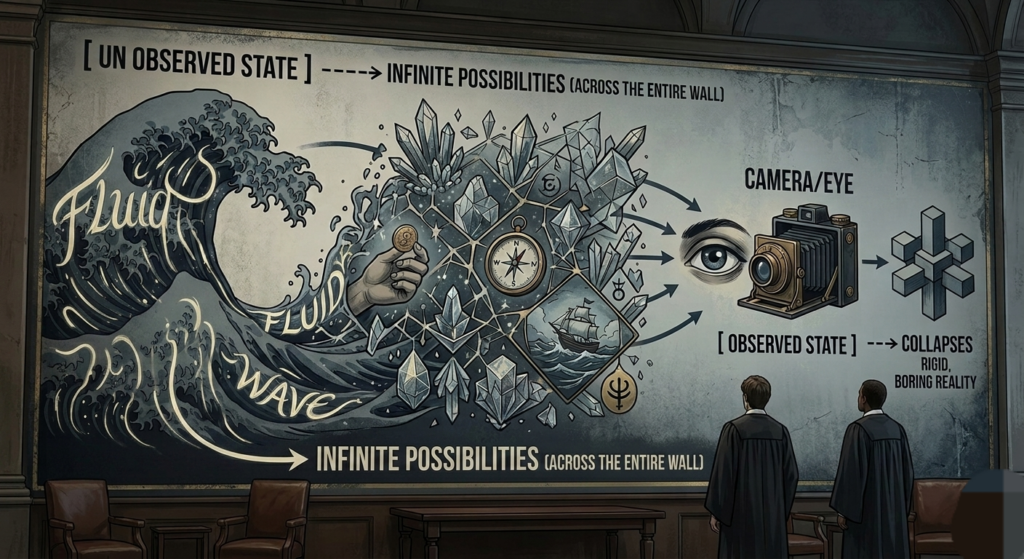
To understand why forcing things rebounds,we have to look at the physics.In the classic quantum double-slit experiment,scientists fired light particles (photons) through two tiny slits toward a back wall.When no one was watching:The light behaved like a fluid wave.It didn’t choose a single path; instead,infinite possibilities rippled through both slits at once,spreading a beautiful interference pattern across the entire wall.
The core lesson of the experiment is simple yet shattering:the moment we obsessively monitor a situation,we act as an intrusive observer that freezes what was meant to be fluid.When this concept is applied to daily life,it reveals a profound truth about the heavy psychological cost of trying to force control.
We have all lived through this quantum paradox, even if we didn’t realize it at the time.Take the story of a freelance graphic designer who spent six weeks aggressively cold-emailing potential clients, obsessively refreshing her inbox every twenty minutes,and manually tracking her LinkedIn profile views.For weeks,the silence was deafening.The rigid “particle” state of her business refused to budge because her anxiety was smothering the field.Exhausted and thoroughly defeated,she decided to close her laptop on a Friday afternoon and take a weekend completely off grid to hike with a friend.She committed to not checking her phone once.When she opened her laptop on Monday morning,she didn’t just have one response—she had three.Two cold leads had replied simultaneously, and an old client had randomly referred a massive project out of nowhere.The moment she removed the suffocating weight of her constant observation, the wave functions collapsed into reality.
The Psychology of Forcing It
The Law of Least Effort:In psychology, this aligns closely with the Backwards Law (popularized by philosopher Alan Watts),which states that the harder you try to pursue a negative experience ( like forcing a creative project to be perfect),the more you reinforce the feeling that you lack it.
When we force things,we operate from a state of desperation.This hyper-observation creates three distinct blocks:
Micro-Management Anxiety: Just like watching a kettle boil makes the time feel longer,tracking a goal every hour makes you prone to frustration,leading you to quit early.
Tunnel Vision:When you decide a goal must happen in one specific way,you blind yourself to the organic,unexpected opportunities rippling across “the entire wall” of your life.
Smothering Energy:In relationships,desperate observation manifests as over-analyzing text response times or constant reassurance-seeking, which naturally pushes people away.
Interactive Workshop: Finding Your “Camera”
Prompt 1:Identify Your Slits
What is the one area of your life right now where you feel stuck in a rigid pattern (e.g., dating, job hunting, creative writing, health)? Write it down.
Prompt 2: Spot the Observer Effect
How often are you “measuring” this goal? Be honest. Are you checking an app five times a day? Are you refreshing an inbox? What is your version of placing a camera at the slits?
Prompt 3: Design Your “Look Away” Protocol
Enter the Double-Slit Experiment.This famous quantum test serves as the ultimate metaphor for human obsession,manifestation,and the art of letting go.Your inability to move forward isn’t a lack of effort.It’s a structural limitation outlined in the Double-Slit Experiment.
What is one radical act of surrender you can perform over the next 48 hours to take your eyes off the kettle? (Example: Deleting a social media app for the weekend, pausing dating apps for a week, or committing to not checking sales numbers until Friday afternoon).
If you’re accidentally freezing a part of your life by staring at it too hard?
Step Back to Let It In
Ultimately,we must learn that the hardest part of growth isn’t building up the hustle—it’s mastering the art of the surrender.Hyper-focusing on our desires narrows our horizon,making our daily anxieties feel incredibly heavy.If you find yourself trapped,endlessly staring at a closed door,a stagnant career move,or a silent phone screen,take a deep breath and step back. Look away for a while. Give your thoughts room to expand,focus on your community,and immerse yourself in the flow of life. You might just find that the second you stop forcing the wave to collapse,the universe finally delivers exactly what you’ve been waiting for.