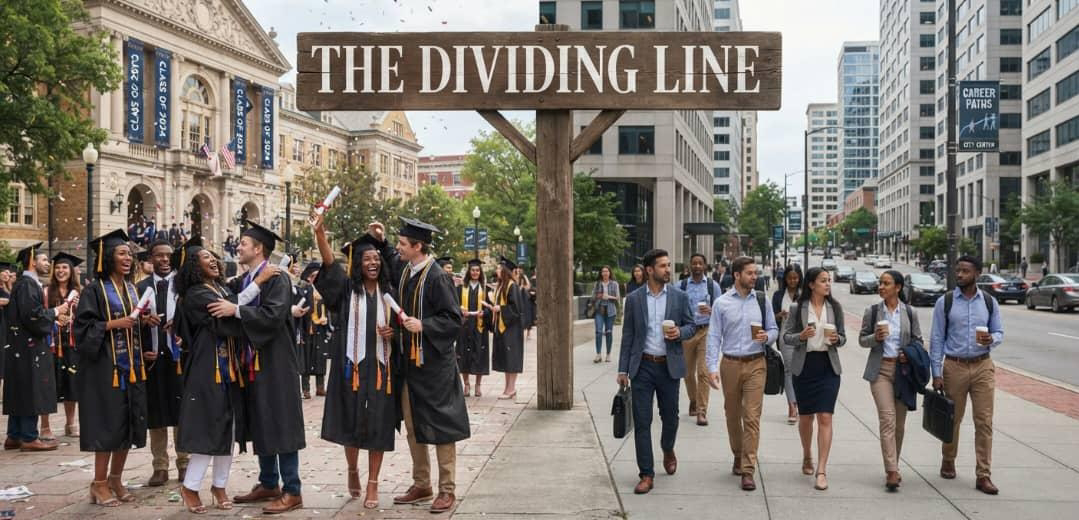
The final walk across the graduation stage is less of a finish line and more of a sudden cliff edge. For nearly two decades,your life was structured by an invisible,highly efficient conveyor belt. Kindergarten led to primary school,secondary school led to university,and semesters led predictably to summer breaks.Success was clearly quantified by a GPA,a test score,or a red pen mark on an essay.You knew exactly where you stood in relation to your peers and what was required to reach the next tier.
Then,the ceremony ends and the gown is returned.The campus that felt like the center of the universe transforms into a collection of buildings for someone else.One moment,you are a student with no worries except project submissions and preparing for exams.The next moment,it dawns on you that all the free allowances you get are about to come to an end.
Life after school is sudden,jarring transition from a structured environment to a completely mapless reality.No one assigns you reading material to prepare for a career pivot,a sudden layoff,or the profound isolation of moving to a city where you know no one.
This exploration examines the psychological, financial, professional, and social architecture of life after academia, offering a realistic blueprint for navigating the great divergence.
1• The Psychological Shock of Autonomy
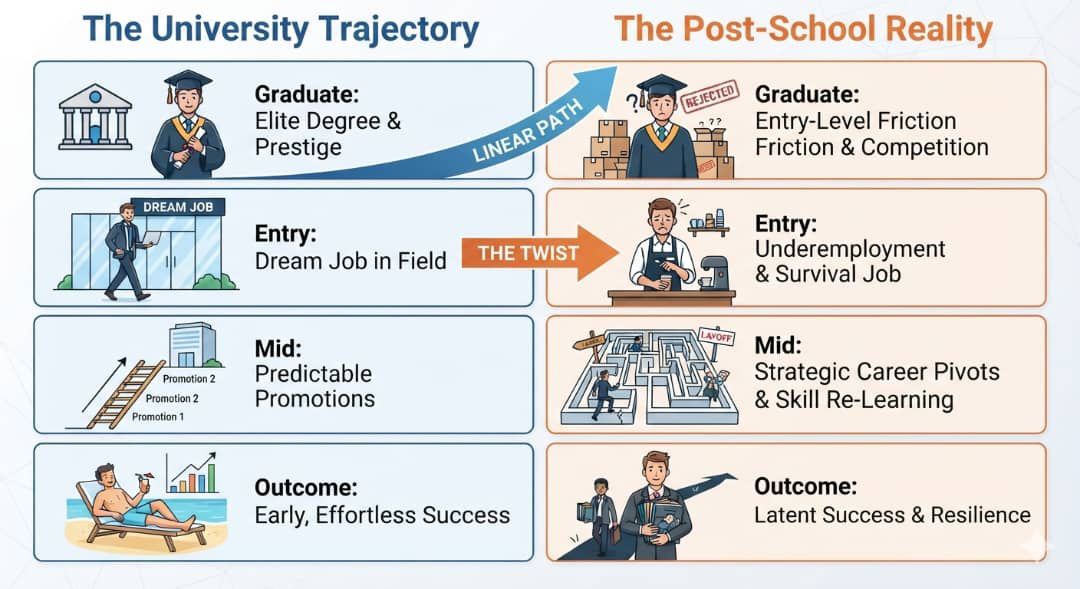
In school,choices are curated.You choose from a drop-down menu of majors,electives,and extracurriculars.The boundaries are fixed.After graduation, the menu disappears, replaced by an infinite expanse of options.This autonomy,while liberating on paper,frequently manifests as a paralyzing psychological shock.
2• Choice Overload and Decision Fatigue
When you can move to any city,apply for any job, or reinvent your identity at any moment,the sheer volume of possibilities can cause mental stagnation.In psychology,this is known as the paradox of choice.Barry Schwartz famously documented that an abundance of options leads to higher anxiety and less satisfaction with the ultimate choice made.
In the post-school landscape, decision fatigue sets in rapidly. You are forced to make high-stakes choices about leases, employment contracts, health insurance, and retirement funds while simultaneously trying to figure out who you are outside the context of a classroom.
3• The Loss of Built-In Validation
Academia operates on a short-loop feedback system. You study, you take an exam, you receive a grade. This loop provides constant external validation, assuring you that you are making progress.
The professional world operates on a vastly different timeline.You may work diligently on a corporate project for nine months,only for it to be shelved due to a budget cut.Your manager might not praise your daily outputs.Raises and promotions occur annually,if at all. Learning to survive without constant,external gold stars is one of the most difficult emotional adjustments a new graduate must make.You have to learn to validate yourself.
4• Identity Foreclosure and the Post-Grad Blues
For twenty years,your answer to the question “What do you do?” was simple:”I am a student.” This identity carries societal respect,built-in excuses for financial hardship,and a clear purpose.
When that title is stripped away,many alumni experience identity foreclosure—a state where they feel entirely anchorless.The “post-grad blues” is a very real, documented phenomenon characterized by mild depression,lethargy, anxiety about the future,and a deep nostalgia for the relative simplicity of school life.
5• The Professional Wilderness: Career vs. Job
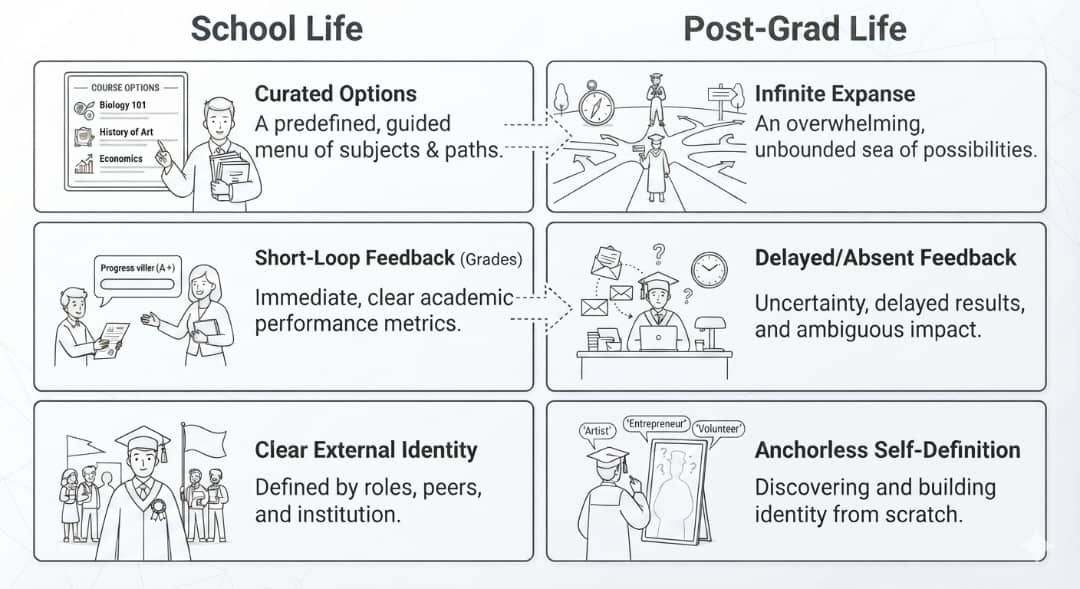
The modern job market rarely accommodates the idealized trajectories sold in university brochures.Very few graduates step directly into their dream roles.Instead,most enter a professional wilderness characterized by entry-level friction,misaligned expectations,and corporate bureaucracy.
6•The Paradox of the Entry-Level Role
The most immediate hurdle face by new graduates is the infamous catch-22:“Requires 3–5 years of experience for an entry-level position.” This structural barrier can be deeply demoralising.It reveals a fundamental disconnect between what universities teach (theory and abstract problem-solving) and what employers want (immediate operational utility,tool proficiency,and industry context).
Surviving this phase requires a shift in strategy:
●The Portfolio Shift:Degrees are no longer differentiators;proof of capability is.Building a digital portfolio,coding public repositories,or publishing industry analyses can bypass traditional HR filters.
• The Non-Linear Path:Your first job out of school is rarely your career.It is often just a mechanism to pay rent and acquire foundational professional skills,such as email etiquette, spreadsheet management,and cross-functional communication.
7.Decoding Workplace Politics
School is largely a meritocracy based on individual output.If you write an excellent paper, you get an A,regardless of whether the professor likes your personality.
The workplace is an ecosystem governed by human relationships,competing incentives,and office politics.
• The Myth of Pure Merit:Doing good work is only half the battle.The other half is visibility—ensuring that decision-makers know you did the work.
• Managing Up:This critical skill involves understanding your manager’s priorities, communication preferences,and anxieties,then tailoring your workflow to alleviate their stress.
8.The Pivot as a Norm, Not a Failure:
The concept of a “job for life” is dead.Data shows that the average modern professional will change careers (not just jobs) multiple times over their working life.
Changing your mind about your industry six months after graduation is not a waste of your degree;it is data collection.You tried a path,realized it did not align with your strengths or values,and adjusted your course.
• The Financial Matrix:From Allowance to Asset Allocation
Nothing defines life after school quite like the sudden,unyielding reality of personal finance.For many,graduation coincides with the arrival of student loan repayment notices,rent obligations, utility bills,and the stark realization of how expensive it is simply to exist.
•The Danger of Lifestyle Creeps: When you receive your first consistent professional paycheck,the temptation to upgrade your lifestyle is intense.Moving into a solo apartment,eating out frequently,and buying a new vehicle can instantly swallow your increased earnings.This is known as lifestyle inflation or lifestyle creep.It binds you to jobs you might dislike because you require the cash flow to sustain your new overheads.
•The Framework of Financial Independence: To build long-term stability after school,you should establish a basic financial framework during your first year in the workforce.
•The Emergency Fund:Accumulating three to six months’ worth of living expenses in a high-yield savings account.This acts as an emotional buffer against job loss,medical emergencies,or car breakdowns.
•The Debt Attack Plan:Prioritizing high-interest debt (like credit cards) while systematically chipping away at student loans using methods like the debt snowball or debt avalanche.
• Automated Investing:Utilizing compound interest early.Allocating even a small percentage of your income to retirement accounts or low-cost index funds in your twenties yields far greater results than trying to save triple that amount in your forties.
9•The Reconstruction of Social Circles
In school,friendship is passive:You are surrounded by thousands of people your own age who share your schedule,your socioeconomic status,and your geographic location.Friendships form organically through shared dorms,group projects,and late-night campus diners.
After school,friendship requires radical intentionality.
•The Loneliness Epidemic Among Young Adults:One of the least discussed aspects of life after school is the profound loneliness that often hits within the first 12 months.When your college friends scatter across the country or world for jobs,your daily social interactions may drop to coworkers and cashiers.
9•The Reconstruction of Social Circles
In school, friendship is passive: You are surrounded by thousands of people your own age who share your schedule,your socioeconomic status, and your geographic location. Friendships form organically through shared dorms, group projects, and late-night campus diners.
After school,friendship requires radical intentionality.
•The Architecture of Adult
Friendships:Maintaining connections post-graduation requires moving away from convenience-based socializing toward scheduling-based socializing.
•The Shared Interest Anchor:Joining recreational sports leagues,professional associations,run clubs,or pottery classes recreates the proximity and repeated exposure that made school friendships easy.
The Vulnerability Gap:Making friends as an adult requires the courage to say, “I’m new to this area and trying to meet people;would you like to grab coffee sometime?” It feels awkward,but it is necessary.
•Embracing Evolving Relationships :You will grow apart from some of your closest school friends,and that is normal.People evolve at different speeds in their twenties.Some will get married and buy homes early;others will move abroad or switch fields entirely,there is no syllabus for your twenties or thirties.Celebrate the seasons you shared with people,without forcing relationships that no longer fit who you are becoming.
10• The Executive Function Tax :Managing a household while working a full-time job demands significant executive function.Meal prepping,laundry,managing doctors’ appointments,and tracking subscriptions can quickly become overwhelming if left unorganized.
Successful transition into adulthood often relies on developing simple operational systems:shared calendars,weekly cleaning routines,and basic cooking skills that do not rely on takeout.
•The Decline of the Untrained Body:In your late teens and early twenties,your body can withstand poor sleep,low-quality diets,and minimal exercise without immediate consequence.
By your mid-twenties,that buffer begins to erode.
•Sleep Hygiene:Prioritizing 7–8 hours of sleep becomes a competitive advantage for your productivity and mental health.
•Nutritional Shift:Shifting from cheap processed foods to balanced,nutrient-dense meals directly impacts your daily energy levels and stress tolerance.
Movement: Finding a form of physical activity you enjoy—whether weightlifting,yoga, swimming,or walking—is crucial for offsetting the sedentary reality of most office jobs.
• Dealing with the Timeline Obsession:Perhaps the greatest psychological trap of life after school is the comparison matrix,accelerated by social media.You look at your feed and see a classmate securing a prestigious role,another getting engaged,and another buying a home.It feels like you are losing a race you did not even know you were running.
The Illusion of the Linear Timeline:
The societal timeline—graduate by 22,marry by 27,buy a house by 30,executive by 35—is an outdated relic of a completely different economic era.Believing in it creates immense,unnecessary suffering.
11• Strategic Blueprint for the First Five Years Out
To synthesize these challenges into actionable steps, here is a practical framework for navigating the first five years after leaving school.
Year 1:Stabilization and Calibration
Objective:
Survive the transition and build a baseline.
Actions:Secure any stable income stream, build a basic monthly budget,establish a consistent sleep routine, and do not make any major,irreversible financial commitments (like buying an expensive new car).Focus entirely on adjusting to the rhythm of working 40+hours a week.
Years 2–3: Optimization and Skill Deepening
Objective: Identify your strengths and optimize your environment.
Actions: Begin looking for your second job or a promotion if your first role offers no upward mobility.Use the market data you collected in Year 1 to negotiate a higher salary.Dedicate time outside of work to learning high-leverage skills (data analysis,public speaking,negotiation, technical writing).
Years 4–5: Leverage and Boundary Setting
Objective: Assert autonomy and build deep equity.
Actions: At this stage,you should transition out of entry-level dynamics.You understand how the corporate world works,you have solid financial habits, and you have built a small but reliable network.Start shifting your focus toward long-term asset building, establishing firm boundaries between your work and personal life, and mentoring those who are just graduating behind you.
Conclusion:
The Blank Canvas-Life after school is undeniably daunting.It strips away the comfort of guardrails, the predictability of semesters,and the easy validation of grades.It forces you to look at a blank canvas and take responsibility for every stroke of the brush.
But this mapless world also offers an extraordinary gift:Absolute Agency
For the first time in your life,you are not living a script written by parents,teachers,or admissions boards.You get to decide what matters to you, what kind of person you want to be,and how you want to define success.
The wilderness is vast, and you will get lost occasionally.But getting lost is a necessary part of discovering where you actually want to go. Embrace the uncertainty,build your foundations patiently,and remember that the race is long,and in the end, it is only with yourself.